Monday, October 13, 2008

The Evolution of My Hair


Introducing: Monique Campbell who is a London-born writer. Her work has appeared in Decode Magazine, anthologies such as Brown Eyes and Sexual Attraction Revealed. Monique has articles published on websites including www.literatenubian.org and www.fiba-filmbank.org

The Evolution of My Hair

From plaits to canerows to braids to hair-relaxers and then on to weaves – the journey of my hair seems never ending. Back in the day prior to teeny-bop-hood, during the latter years of primary school when innocence still reigned upon me, having my hair divided in two to four sections used to be the ‘lick’…well so my mother thought.

I had long tresses of thick stranded semi-kinky hair that was marble-black and could locs with ease, which my mother found hard to manage. These two and four-sectioned partings of my hair where the tresses hung limp in my mother’s hands and then transfixed into two or four plaits, were the repercussions of lacking time. And so I continued my primary school years with an inclination to learn how to groom my hair.

Teeny-bop-hood was infested with cravings for change: experimentation took centre-stage. I cane-rowed my hair backwards, frontward, zigzag, incorporated shapes that seemed for paper alone. I braided my hair thin, fat, with synthetic extensions, human extensions, no extensions. I cried experimentation, enjoyed the attention so much so that I dyed half my hair! The colour of the sun as it set upon the hilltop in Sunset Beach, still possessing my inherited frizz that Dax often shocked into waves.

My hair, I thought, was the coolest. Even when weave interfered with my natural long mane, luring me in with the prospect of wispy feathery European hair that moved airily in the wind and brushed across one’s face, I thought I looked the coolest. I was edgy, had those funky cuts set on trend just like those commercial magazines displayed, except most of them did not reflect me. My decision to relax my hair was because I wanted to adopt this look permanently. Have my hair blowing in the wind as it did with the weave, but permanently.

With adulthood came again a time for change. I started to establish my identity, accept the things that made me, me. There were various contributing factors that drove me to my decision for this new type of change. One being that my hair was damaged and had lost its good quality and volume, the other being acceptance; the ability to accept the order and aesthetics of life, no matter which hand got dealt: dark-skin, light-skin, long-hair, short-hair, broad-nose, thin-nose, straight-hair or afro-hair. Ageing is unstoppable as are the seasons that follow one another, unfaltering in their existence.

All that said, I currently stand at a cross-road between principles and the dictatorship of time. At the age of 26 with seven willing years of strenuous management and gregarious results of natural hair under my belt, I am contemplating texturising. Not because I want to aspire to look like someone else or I’m unable to accept the natural conditions of my hair, but because I’m unable to provide my hair with the time it needs.

No longer do I have those spare 4-6 hours to wash, condition and twist my hair every two-weeks so that it looks presentable. My hair comes down to the centre of my back, can easily make three sets of heads and has curls that locs with ease. So my question is this: do I pander to my principles of acceptance? Or do I bow down to the dictatorship of time and put a solution in my hair that will merely loosen the curls and make it easier to manage whilst keeping the natural look (as put by my hairdresser From the Roots)?

Friday, October 10, 2008

Locs Journey: Part Two


…Ten years of numerous styles later, including braid extensions, relaxing, blow drying and texturising, and I re-started growing my hair into locs in September 2006, which like last time was more than choosing a hairstyle.

This time round, I now know how to treat and condition my locs with natural products such as oils and oil sheens. My personal loctician has taken great care of my locs.

I have had my locs for two years now and they are here to stay. They hold a spiritual meaning for me in that they are an expression of my connection to and appreciation for my African heritage. I feel this is a natural response to the African Caribbean vibrations of my African ancestry.

I see this decision as a way of life; a cultural expression of pride in my ethnic identity. Wearing locs is also a way of freeing myself both figuratively and literally from the dictates of western European fashion. My hair is finally at ease, relaxed and free and I love every minute of it.

I love my locs; they feel nice to touch and I find myself doing just that – feeling each and every unique dred on my head. This is something that I never did when my hair was in other less natural styles.

Author Alice Walker, who has worn her hair in locs since the 1980s, once wrote, ‘Bob Marley is the person who taught me to trust the universe enough to respect my hair; as he shook his lion’s mane, the confidence, the love, and the sheer commitment to Blackness and to Jah was in his every moment.’

By Nicole Moore

Tuesday, October 7, 2008

Locs Journey: Part One


Introducing Nicole Moore, Creator of this hair stories blog. Nicole was born in London and is a freelance writer, editor, published poet and arts consultant. She is the founder of Shangwe and the co-founder of Words of Colour Productions. Nicole is editor of two collections of poetry and autobiographical writing by black and mixed race women: Brown Eyes (2005) and Sexual Attraction Revealed (2007).

Locs Journey: Part One

The year 1995 was significant for a number of reasons. I studied black women’s literature and then took a course: 'From Motherland to ‘Motherland’: Black Women's History.' Both Birkbeck College courses lasted 6 months each and were led by Dorothea Smartt and held at the Claudia Jones Organisation in East London.

What’s this got to do with my hair story you may well ask. Well studying black women’s writing gave me the rare opportunity to delve, with others, into the worlds of African-Caribbean and Black British writers. I was able to deepen my understanding of issues affecting black women at large through literature, whilst discussing and sharing my own ideas.

The black women’s history course gave me the opportunity to examine aspects of African-Caribbean women’s ancestry and contemporary history. Selected readings and discussions formed the basis for the exploration of sex, gender, race and class issues in telling ‘his/story’. Readings included black radical and feminist historians, oral history and Caribbean women’s literature as a source of history.

All of this studying was particularly encouraging and enlightening and set me on a path of exploration, which has continued until this day. It is no surprise to me that the positive affects of studying in this way has been a contributory factor, which supported by decision to locs my hair, even though I didn’t know whether my ‘mixed’ hair would locs.

‘Back to Eden’ a South London hairdressing salon specialising in natural hair, started my locs on 30th July 1995. (I think the hairdresser/owner’s name was Cynthia). All went well to a certain degree and I kept my locs for two years (pictured above).

However, it was the issue of maintenance that caused me to re-consider this choice as my hair became dry and brittle as I was following Back to Eden’s ethos of natural hair being washed, with nothing added, i.e. no oil, moisturising, etc. As a result, I decided to change my hairstyle and cut my locks.

To be continued…

Saturday, October 4, 2008

Hair to Stay


Introducing Brenda White, who has always had an interest in performing, and from a young age took part in school productions and performances. Brenda’s interest in drama and performing has taken her in many directions since studying a B-Tec National Diploma in Performing Arts in 1994.

Her career experiences range from acting roles, coordinating events, to working with young people, and directing plays for the stage. Brenda has an imaginative mind, and enjoys creating new ideas, using drama or literature. One of Brenda’s future goals is to produce a play or film about the lives of first generation British Caribbean people growing up in England, and how unique an experience that was.

Hair to Stay

I could think of so many hair stories. It’s been really hard knowing which story to share. I could tell you about the stories of having my hair washed as a child, and how much I hated it, or even the dreaded anticipation I had when my mum would practically rake the comb through my hair that was left uncombed for days.

Yes… I have had my ups and downs with my hair just like everyone else. I have tried various styles and textures over the years from cornrows and braiding to relaxing.

Relaxing required regular maintenance, and is not surprising when you think of the chemical contents. At least once a month I would go to the hairdressers for a steam and maybe have the ends clipped to stop split ends. This would set me back at least fifty pounds.

I would spend a fortune to look beautiful and groomed, especially when it came to my hair. My hair did look good, but there was no way I could keep this up forever. I wondered what my hair would look like if I stopped relaxing it. ‘You will have to cut it out gradually or it will break’, my hairdresser advised me.

Eleven years ago while pregnant, I made the decision that I wanted my hair natural, maybe even locks. My influence had come from an understanding of myself and my culture. This included music influences, for example, Bob Marley, Burning Spear, and my visits to the Caribbean.

I was now thirty five and I wanted a new look. Then it dawned on me that my hair was part of my uniqueness. My new look would now represent me and my heritage. I concluded that my hair was my connection to my people. Anywhere in the world I saw people with hair like mine, I knew that they were connected to me and the African Diaspora.

Africans are the only race with tightly curled hair. I read that it is like this to keep us cool in the hot sun of the African continent. To me, it helps us to stand out as a nation. We may be some of the most deprived people in the world, but our presence can never be denied.

It took me years to come to my decision and I am glad that I did. I am proud of my blackness and I wear my hair in many beautiful natural styles, mainly afro; a style that stood for liberation for black people back in the seventies. I wear my hair with pride and as a continuation of one of the physical traits of my people.

Wednesday, October 1, 2008

Hear My Lifetime Hair Journey


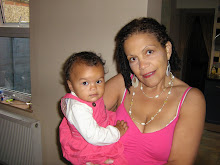
Introducing Lavern Buchanan-Sy, (pictured above with her daughter Zeyna) a mother of three (a son and two daughters) whom she views as her greatest achievement. Lavern was born in Clapham and grew up in Croydon. She studied sociology at Greenwich University and completed a Careers Guidance postgraduate qualification at University of East London. Lavern works as an Aspire Project Officer/Life Long Learning Co-ordinator in a London F.E College.

Hear My Lifetime Hair Journey

Born with a head free of chemicals, combs and conditioners, my hair naturally curled into a beautiful black shiny covering. It soon became pomades, hot combs warmed by the paraffin heater to remove all trace of its natural naturalness. My mother wanted a style that would curb an unruly mess. I would endure the burnt ears to have a creation that I could comb and flick through, much like my blond and brunette peers, fear of rain and water entering my recreational swim ruining its slick condition.

Then like the sunrise, the 70’s arrived and a woman across the Atlantic revolutionised mine and so many sisters’ crown and glory to create another story. We walked with pride as our hot combs were binned and replaced with combs of red green and black plastic and metal teeth, wooden crafted creations’ artistry that remained a lasting legacy of freedom and liberation. My awakening journey truly began. “Thank you “Angela.

Bonding with my sister sibling, a natural born stylist, beautiful adornments of rows of plaits, sometimes braided or lengthened with extensions of synthetic that looked like my own and lasting for months, would be removed as it started to take a journey of its own.

I loved the attention received of gasping admiration for these unique and expressive twists. Travelling to Africa’s continent in Senegal, the plaits were developed further into the crème de la crème of my hair expression; microscopic detail with shell beads, coins to add the final touch - truly an African queen connected to a family left unintentionally hundreds of years ago. Welcome home child.

My daughters arriving showed me some new and original styles of their own. The scissors intercepted throughout this journey at significant times. Sitting in a barber’s chair I would receive from my opposite gender a quizzical and discomforting stare; what was my sister doing in here?

My shaven head the final result would then be coloured in coppers and reds and the comb replaced with a soft brush - complete ease and ready to please. Hairdressers completely redundant with me, why no perm, no tongs, no weave No, No, No……..

Here we are now, my hair locked in a style deemed wayward, condemned, scorned and even criminalised in an island that waves its flag of Yellow, Green and Black. Oh their wearer’s received such hatred and flack.

These beautiful knots completely freed me of combs and are replaced with fingers that manoeuvre every single strand within a god blessed locktitians hand. My shaved coloured head of five years ago now sits on my shoulder, carrying with it my stories of life changes, none more significant than the loss of the man, my father that assisted in my creation but also the glory of seeing my eldest and only son’s graduation.

My adornment now covers the aids that assist my diminished hearing; vanity. Practicality or pride, my hair and its life journey continues with ultimate love and growth within and outside.